Vrindavani Vastra: A Sacred Silk’s Journey across Centuries
What is Vrindavani Vastra, and how has the Government of Assam made efforts to revive, preserve, and bring back this historic textile heritage of Assam
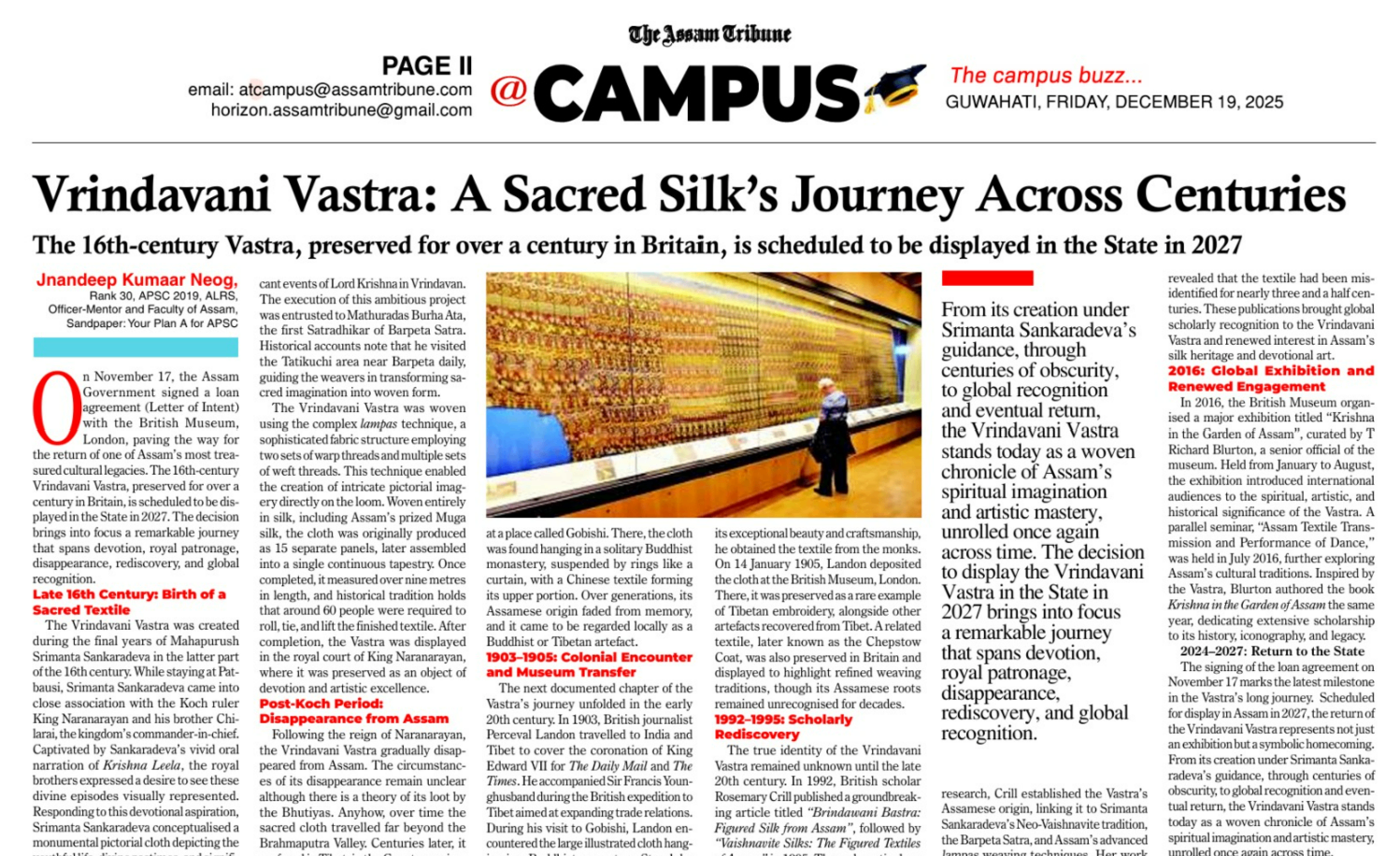
Vrindavani Vastra: A Sacred Silk’s Journey across Centuries:
On November 17, the Assam Government signed a loan agreement (Letter of Intent) with the British Museum, London, paving the way for the return of one of Assam’s most treasured cultural legacies. The 16th-century Vrindavani Vastra, preserved for over a century in Britain, is scheduled to be displayed in the State in 2027. The decision brings into focus a remarkable journey that spans devotion, royal patronage, disappearance, rediscovery, and global recognition.
Late 16th Century: Birth of a Sacred Textile:
The Vrindavani Vastra was created during the final years of Mahapurush Srimanta Sankardeva in the latter part of the 16th century. While staying at Patbausi, Sankardeva came into close association with the Koch ruler King Naranarayan and his brother Chilarai, the kingdom’s commander-in-chief. Captivated by Sankardeva’s vivid oral narration of Krishna-Leela, the royal brothers expressed a desire to see these divine episodes visually represented. Responding to this devotional aspiration, Sankardeva conceptualised a monumental pictorial cloth depicting the youthful life, divine pastimes, and significant events of Lord Krishna in Vrindavan. The execution of this ambitious project was entrusted to Mathuradas Burha Ata, the first Satradhikar of Barpeta Satra. Historical accounts note that Sankardeva visited the Tatikuchi area near Barpeta daily, guiding the weavers in transforming sacred imagination into woven form.
The Vrindavani Vastra was woven using the complex lampas technique, a sophisticated fabric structure employing two sets of warp threads and multiple sets of weft threads. This technique enabled the creation of intricate pictorial imagery directly on the loom. Woven entirely in silk, including Assam’s prized muga silk, the cloth was originally produced as 15 separate panels, later assembled into a single continuous tapestry. Once completed, it measured over nine metres in length, and historical tradition holds that around sixty people were required to roll, tie, and lift the finished textile. After completion, the Vastra was displayed in the royal court of King Naranarayan, where it was preserved as an object of devotion and artistic excellence.
Post-Koch Period: Disappearance from Assam:
Following the reign of Naranarayan, the Vrindavani Vastra gradually disappeared from Assam. The circumstances of its departure remain unclear although there is a theory of its loot by the Bhutiyas. Anyhow over time the sacred cloth travelled far beyond the Brahmaputra Valley. Centuries later, it surfaced in Tibet, in the Gyantse region, at a place called Gobishi. There, the cloth was found hanging in a solitary Buddhist monastery, suspended by rings like a curtain, with a Chinese textile forming its upper portion. Over generations, its Assamese origin faded from memory, and it came to be regarded locally as a Buddhist or Tibetan artefact.
1903–1905: Colonial Encounter and Museum Transfer
The next documented chapter of the Vastra’s journey unfolded in the early 20th century. In 1903, British journalist Perceval Landon travelled to India and Tibet to cover the coronation of King Edward VII for The Daily Mail and The Times. He accompanied Sir Francis Younghusband during the British expedition to Tibet aimed at expanding trade relations. During his visit to Gobishi, Landon encountered the large illustrated cloth hanging in a Buddhist monastery. Struck by its exceptional beauty and craftsmanship, he obtained the textile from the monks. On 14 January 1905, Landon deposited the cloth at the British Museum, London. There, it was preserved as a rare example of Tibetan embroidery, alongside other artefacts recovered from Tibet. A related textile, later known as the Chepstow Coat, was also preserved in Britain and displayed to highlight refined weaving traditions, though its Assamese roots remained unrecognised for decades.
1992–1995: Scholarly Rediscovery
The true identity of the Vrindavani Vastra remained unknown until the late 20th century. In 1992, British scholar Rosemary Crill published a groundbreaking article titled “Brindawani Bastra: Figured Silk from Assam”, followed by “Vaishnavite Silks: The Figured Textiles of Assam” in 1995. Through meticulous research, Crill established the Vastra’s Assamese origin, linking it to Sankardeva’s Neo-Vaishnavite tradition, the Barpeta Satra, and Assam’s advanced lampas weaving techniques. Her work revealed that the textile had been misidentified for nearly three and a half centuries. These publications brought global scholarly recognition to the Vrindavani Vastra and renewed interest in Assam’s silk heritage and devotional art.
2016: Global Exhibition and Renewed Engagement
In 2016, the British Museum organised a major exhibition titled “Krishna in the Garden of Assam”, curated by T. Richard Blurton, a senior official of the museum. Held from January to August, the exhibition introduced international audiences to the spiritual, artistic, and historical significance of the Vastra. A parallel seminar, “Assam Textile Transmission and Performance of Dance,” was held in July 2016, further exploring Assam’s cultural traditions. Inspired by the Vastra, Blurton authored the book Krishna in the Garden of Assam the same year, dedicating extensive scholarship to its history, iconography, and legacy.
2024–2027: Return to the State
The signing of the loan agreement on November 17 marks the latest milestone in the Vastra’s long journey. Scheduled for display in Assam in 2027, the return of the Vrindavani Vastra represents not just an exhibition but a symbolic homecoming. From its creation under Sankardeva’s guidance, through centuries of obscurity, to global recognition and eventual return, the Vrindavani Vastra stands today as a woven chronicle of Assam’s spiritual imagination and artistic mastery, unrolled once again across time.
