Batadrava: Where Assam’s Civilizational Story Breathes
How will the newly inaugurated Mahapurush Srimanta Sankardeva Abirbhav Kshetra at Batadrava help in preserving and promoting Assamese culture, spirituality, and tourism, and what role does the Assam Government envision for this site in the future. We will update about the project in detail here.
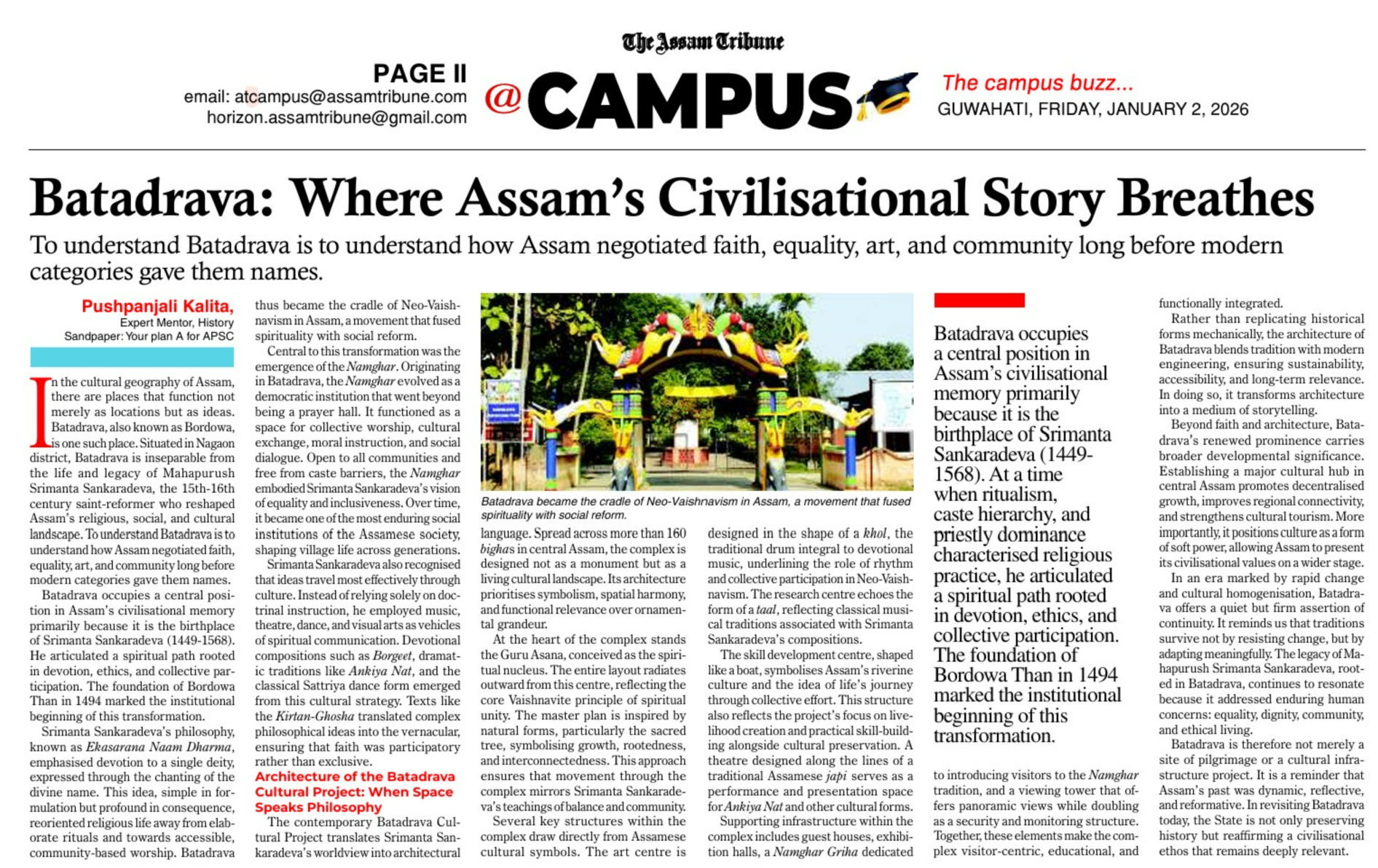
Batadrava: Where Assam’s Civilizational Story Breathes:
In the cultural geography of Assam, there are places that function not merely as locations but as ideas. Batadrava, also known as Bordowa, is one such space. Situated in Nagaon district, Batadrava is inseparable from the life and legacy of Mahapurush Srimanta Sankardeva, the 15th–16th century saint-reformer who reshaped Assam’s religious, social, and cultural andscape. To understand Batadrava is to understand how Assam negotiated faith, equality, art, and community long before modern categories gave them names. Batadrava occupies a central position in Assam’s civilizational memory primarily because it is the birthplace of Srimanta Sankardeva (1449–1568). At a time when ritualism, caste hierarchy, and priestly dominance characterized religious practice, he articulated a spiritual path rooted in devotion, ethics, and collective participation. The foundation of Bordowa Than in 1494 marked the institutional beginning of this transformation. Sankardeva’s philosophy, known as Ekasarana Naam Dharma, emphasised devotion to a single deity, expressed through the chanting of the divine name. This idea, simple in formulation but profound in consequence, reoriented religious life away from elaborate rituals and towards accessible, community-based worship. Batadrava thus became the cradle of Neo-Vaishnavism in Assam, a movement that fused spirituality with social reform. Central to this transformation was the emergence of the Namghar. Originating in Batadrava, the Namghar evolved as a democratic institution that went beyond being a prayer hall. It functioned as a space for collective worship, cultural exchange, moral instruction, and social dialogue. Open to all communities and free from caste barriers, the Namghar embodied Sankardeva’s vision of equality and inclusiveness. Over time, it became one of the most enduring social institutions of Assamese society, shaping village life across generations. Sankardeva also recognized that ideas travel most effectively through culture. Instead of relying solely on doctrinal instruction, he employed music, theatre, dance, and visual arts as vehicles of spiritual communication. Devotional compositions such as Borgeet, dramatic traditions like Ankiya Nat, and the classical Sattriya dance form emerged from this cultural strategy. Texts like the Kirtan-Ghosha translated complex philosophical ideas into the vernacular, ensuring that faith was participatory rather than exclusive.
Architecture of the Batadrava Cultural Project: When Space Speaks Philosophy:
The contemporary Batadrava Cultural Project translates Sankardeva’s worldview into architectural language. Spread across more than 160 Bighas in central Assam, the complex is designed not as a monument but as a living cultural landscape. Its architecture prioritizes symbolism, spatial harmony, and functional relevance over ornamental grandeur. At the heart of the complex stands the Guru Asana, conceived as the spiritual nucleus. The entire layout radiates outward from this centre, reflecting the core Vaishnavite principle of spiritual unity. The master plan is inspired by natural forms, particularly the sacred tree, symbolizing growth, rootedness, and interconnectedness. This approach ensures that movement through the complex mirrors Sankardeva’s teachings of balance and community. Several key structures within the complex draw directly from Assamese cultural symbols. The art centre is designed in the shape of a khol, the traditional drum integral to devotional music, underlining the role of rhythm and collective participation in Neo-Vaishnavism. The research centre echoes the form of a taal, reflecting classical musical traditions associated with Sankardeva’s compositions. The skill development centre, shaped like a boat, symbolises Assam’s riverine culture and the idea of life’s journey through collective effort. This structure also reflects the project’s focus on livelihood creation and practical skill-building alongside cultural preservation. A theatre designed along the lines of a traditional Assamese Japi serves as a performance and presentation space for Ankiya Nat and other cultural forms. Supporting infrastructure within the complex includes guest houses, exhibition halls, a Namghar Griha dedicated to introducing visitors to the Namghar tradition, and a viewing tower that offers panoramic views while doubling as a security and monitoring structure. Together, these elements make the complex visitor-centric, educational, and functionally integrated. Rather than replicating historical forms mechanically, the architecture of Batadrava blends tradition with modern engineering, ensuring sustainability, accessibility, and long-term relevance. In doing so, it transforms architecture into a medium of storytelling. Beyond faith and architecture, Batadrava’s renewed prominence carries broader developmental significance. Establishing a major cultural hub in central Assam promotes decentralized growth, improves regional connectivity, and strengthens cultural tourism. More importantly, it positions culture as a form of soft power, allowing Assam to present its civilizational values on a wider stage. In an era marked by rapid change and cultural homogenization, Batadrava offers a quiet but firm assertion of continuity. It reminds us that traditions survive not by resisting change, but by adapting meaningfully. The legacy of Srimanta Sankardeva, rooted in Batadrava, continues to resonate because it addressed enduring human concerns: equality, dignity, community, and ethical living. Batadrava is therefore not merely a site of pilgrimage or a cultural infrastructure project. It is a reminder that Assam’s past was dynamic, reflective, and reformative. In revisiting Batadrava today, the state is not only preserving history but reaffirming a civilizational ethos that remains deeply relevant.
